
Fire Protection Systems
Safe, Controlled and Standards-Compliant Solutions.
Sprinkler, hydrant, fire hose cabinet, pump and special suppression systems designed according to the fire risk of residential buildings, hotels, factories, warehouses, shopping centres, offices, restaurants, plant rooms and industrial facilities.
Request a Quote for Your Project →A fire suppression system is the infrastructure that protects lives and property in a building.
Choosing the right system involves more than selecting equipment or pipes. The risk class, building use, water source, pump capacity, zoning, detection integration and maintenance plan must be assessed together.
Fire suppression systems are installed to control a fire at an early stage, limit its spread and allow evacuation to take place safely. Water-based, foam, gas or water mist solutions are selected according to the building’s risk.
For the client, what matters most is correct system design and complete commissioning tests. Incorrect pipe sizing, an undersized pump, the wrong sprinkler type or a poorly maintained valve set can impair system performance.
A fire protection installation must be designed as a whole.
System performance depends on the water tank, fire pump, valve stations, pipework, sprinkler heads, hydrants, detection system and regular maintenance all working together.
Water source
The fire water tank, mains supply or dedicated reserve is sized according to the fire scenario.
Pump set
Electric, diesel and jockey pumps are selected to deliver the required pressure and flow rate.
Distribution pipework
Galvanised, black steel or suitably certified pipework ensures safe distribution to the zones.
Controls
Monitoring is provided by flow switches, alarm valves, pressure switches and the fire detection system.
Explore our fire protection applications in detail.
Click the relevant system card for more information.
Which fire suppression system suits which building?
The most widely used systems are described below, together with their advantages, limitations, suitable building types and operating requirements.
Sprinkler Fire Suppression Systems
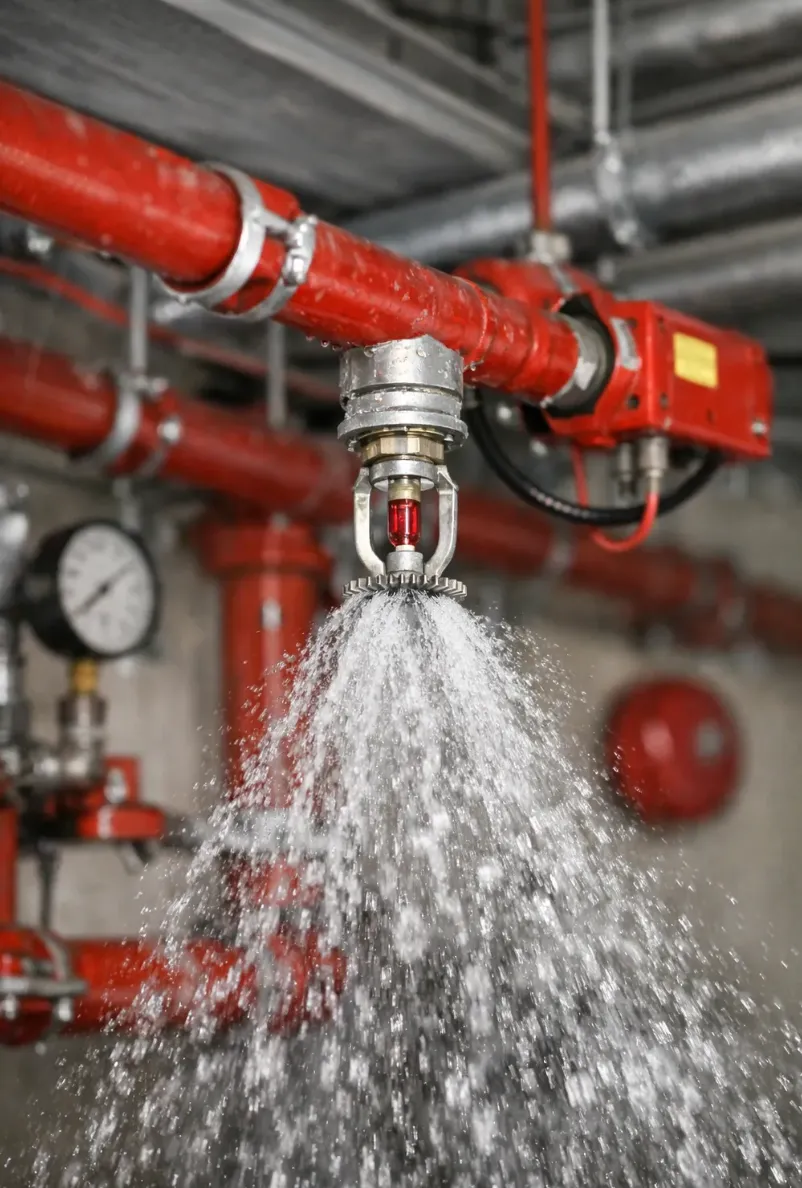
When a fire breaks out, sprinkler systems discharge water only onto the fire area through heat-activated heads. They are one of the most common automatic fire suppression solutions.
Each sprinkler head usually opens at a specific temperature, so only the heads closest to the fire are activated rather than the whole building. This limits water damage while also reducing the spread of the fire.
Advantages
| Suitable buildings | Warehouses, hotels, shopping centres, offices, car parks, production areas, public buildings |
|---|---|
| Weaknesses | Risk of water damage, special solutions needed in areas at risk of freezing, regular testing required |
| Maintenance | Valves, pressure, alarms, flow tests and heads must be checked periodically. |
Wet Pipe Sprinkler System
In wet pipe systems, the pipes are permanently filled with water. When a sprinkler head opens, water reaches the fire area immediately. This is the fastest and simplest sprinkler solution.
Operating principle
| Advantage | Fast response, simple operation, low operational complexity |
|---|---|
| Disadvantage | Not suitable for areas at risk of freezing. |
| Energy consumption | Energy consumption in standby is low; the main consumption occurs when the pumps are running. |
Dry Pipe Sprinkler System
In dry pipe systems, the pipes contain compressed air or nitrogen instead of water. When a sprinkler head opens, the air escapes, the dry alarm valve opens and water fills the pipes.
Where is it used?
| Advantage | Provides a safe solution in areas at risk of freezing. |
|---|---|
| Disadvantage | The response time is slightly longer than with a wet system, and more maintenance is required. |
| Maintenance | The compressor, dry alarm valve, air leaks and drainage must be checked regularly. |
Deluge Fire Suppression System
Deluge systems use open nozzles. When the system is activated, water is discharged at a high flow rate from all nozzles simultaneously. They are chosen for high-risk fires that spread very rapidly.
Suitable applications
| Advantage | Delivers very fast suppression over a large area. |
|---|---|
| Disadvantage | Requires a high water flow rate; the risk of water damage is high. |
| Controls | Works together with the detection system; careful design is needed to prevent unwanted activation. |
Pre-Action Sprinkler System
Pre-action systems are used in sensitive areas to prevent accidental water discharge. The system usually releases water only when there is both a detection signal and an open sprinkler head.
Solution for sensitive areas
| Advantage | Reduces the risk of water damage. |
|---|---|
| Disadvantage | Design and maintenance are more complex than for a conventional system. |
| Suitable buildings | Data centres, archives, museums, laboratories, critical plant rooms |
Fire Hose Cabinets and Hose Reel Systems
Fire hose cabinets are hose systems used inside the building for first response by occupants or trained staff. Unlike sprinkler systems, they require manual intervention.
Main components
| Suitable buildings | Residential buildings, hotels, schools, offices, warehouses, commercial buildings |
|---|---|
| Advantage | Enables an immediate first response. |
| Disadvantage | Requires manual operation; user training is important. |
Fire Hydrant Systems
Hydrant systems are external fire protection installations that allow the fire brigade or authorised teams to draw water when fighting a fire outside the building.
Applications
| Advantage | Enables external firefighting at large facilities. |
|---|---|
| Disadvantage | Requires site pipework, frost protection and regular testing. |
| Maintenance | Flow tests, valve checks, leak checks and visibility checks must be carried out. |
Fire Pump Systems
Fire pumps deliver the flow rate and pressure required by the system. An electric duty pump, a diesel standby pump and a jockey pump are usually used together.
Energy consumption and operating principle
| Suitable systems | Sprinkler, hydrant, fire hose cabinet, deluge and foam systems |
|---|---|
| Advantage | Guarantees the required pressure and flow rate. |
| Maintenance | Weekly/monthly test runs and checks of fuel, batteries, valves and pressure are required. |
Gas Fire Suppression Systems
Gas suppression systems are used in areas where water could cause damage. FM-200, Novec 1230, CO₂ and inert gas systems are among the best-known solutions.
Suitable applications
| Advantage | Provides an effective solution in areas with electronic and sensitive equipment. |
|---|---|
| Disadvantage | Room integrity, occupant safety and evacuation procedures must be carefully planned. |
| Maintenance | Cylinder pressure, nozzles, detection, alarms and the discharge line must be checked periodically. |
Water Mist Fire Suppression Systems
Water mist systems use very fine water droplets to cool the fire and reduce the oxygen supply. They can use less water than conventional sprinkler systems.
Benefits
| Advantage | Potential for effective suppression with little water. |
|---|---|
| Disadvantage | Design and equipment costs may be higher than for a conventional system. |
| Suitable buildings | Historic buildings, hotels, ships, plant spaces, special risk areas |
Foam Fire Suppression Systems
Foam systems cover the surface of flammable liquid fires, reducing contact with oxygen and lowering the risk of re-ignition.
Applications
| Advantage | Effective against flammable liquid fires. |
|---|---|
| Disadvantage | Requires monitoring of the foam concentrate, environmental compliance and clean-up. |
| Maintenance | Foam tanks, proportioning systems, valves and nozzles must be tested. |
What should you consider when choosing a fire suppression system?
1. Building use
Hotels, warehouses, factories, offices, restaurants, car parks and plant rooms do not share the same risk class. The system must be selected according to the building’s use.
2. Risk class
The density of combustible materials, storage height, occupancy and fire load directly affect the capacity calculation.
3. Water source and pump
An inadequate tank volume or the wrong pump can render even the best pipework and sprinkler system ineffective.
4. Maintenance and testing
If a fire protection installation is not tested regularly after installation, it may not perform as expected in an emergency.
| System | Best suited to | Strength | Points to note |
|---|---|---|---|
| Wet sprinkler | Heated indoor areas | Fast and simple operation | Risk of freezing |
| Dry sprinkler | Cold areas | Frost-resistant solution | More maintenance |
| Deluge | High-risk industry | Rapid response over a large area | High water flow rate |
| Gas system | Servers, switchboards, archives | Prevents water damage | Room integrity and occupant safety |
| Water mist | Sensitive and special areas | Lower water consumption | Cost of special equipment |
| Foam system | Flammable liquid hazards | Reduces re-ignition | Monitoring of foam concentrate |
Common questions about fire suppression systems
Does a sprinkler system soak the whole building at once?
No. Usually only the heat-activated heads closest to the fire open.
Does a fire pump consume electricity all the time?
Under normal conditions, the main pumps do not run. Small pressure losses are compensated for by the jockey pump. The main consumption occurs during tests or in the event of a fire.
Is a gas suppression system safe in occupied areas?
That depends on the system type and design. Alarms, a discharge delay, an evacuation procedure and a safety calculation are always required.
Can a fire hose cabinet replace a sprinkler system?
No. A fire hose cabinet is intended for manual intervention, whereas a sprinkler system provides automatic suppression.
Where is a hydrant system required?
On large sites, in factories and in warehouses, hydrant infrastructure is important for external firefighting.
How important is system maintenance?
Very important. If a valve is closed, a pump is not working or the pressure has dropped, the system cannot do its job in the event of a fire.
Which standards apply?
The design must be based on EN standards, NFPA or local fire regulations, depending on national legislation, building use and the required standard.
Can a fire protection system be added to an existing building?
Yes. However, shafts, ceiling voids, space for pumps, the water tank and the existing architectural conditions must be inspected on site.
Let’s plan the right fire suppression system for your building together.
We will prepare a safe and feasible solution based on the building type, risk class, intended use, existing installations, water source and regulatory requirements.