
Solar Heating Systems
Hot water and heating support from solar collectors.
Flat-plate and evacuated tube collectors, a solar cylinder and controls cover a large share of domestic hot water demand. Site survey, design, installation, commissioning and maintenance from one team.
Free Site Survey and Quote →A solar thermal system converts solar energy directly into heat.
It does not generate electricity – it heats water and, when designed for it, supports space heating.
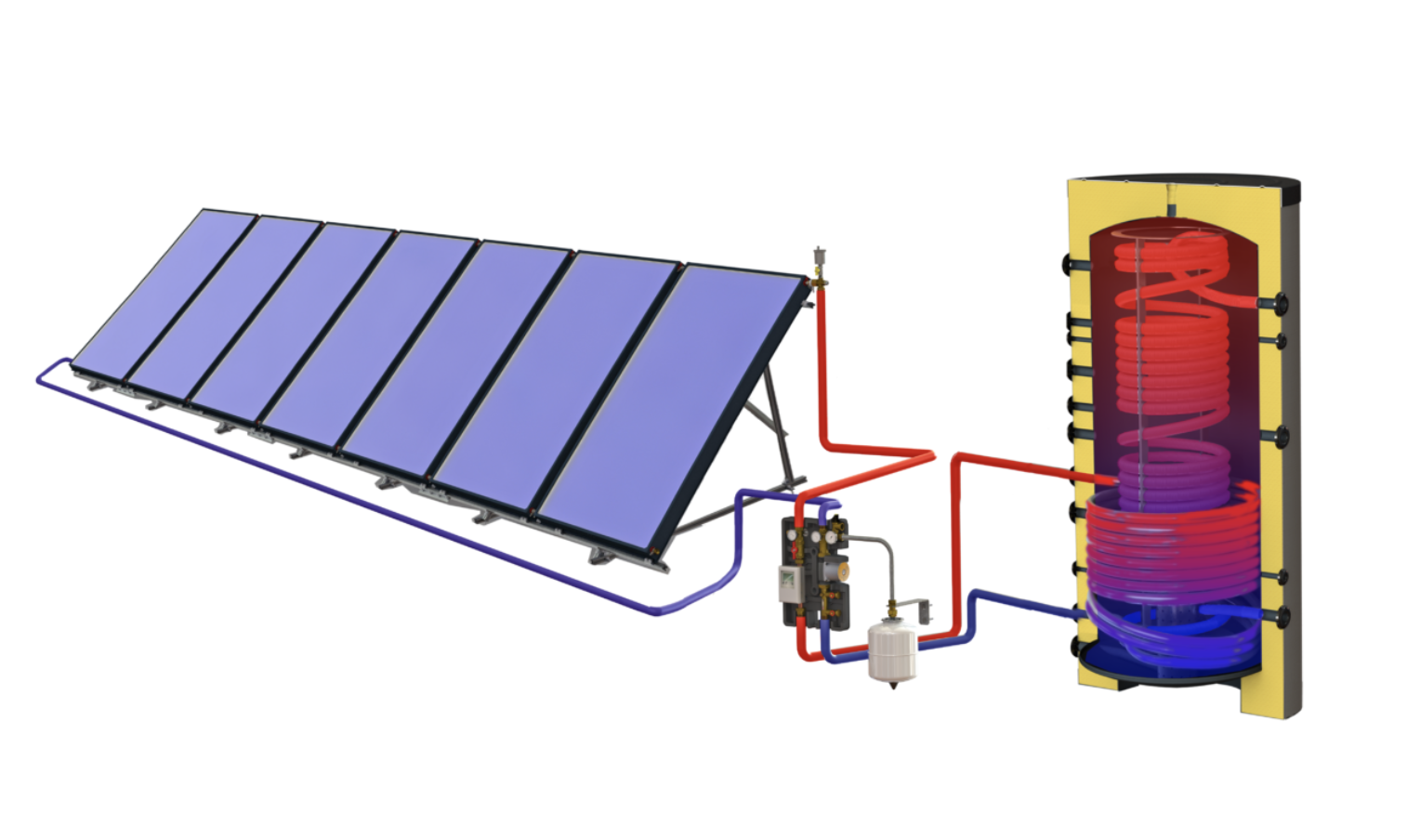
The collector absorber converts solar radiation into heat. A glycol-based solar fluid in a closed loop carries it through the solar pump station to the lower coil of the cylinder. A differential temperature controller starts the pump when the collector is sufficiently warmer than the cylinder.
The upper part of the cylinder is topped up by a boiler, heat pump or immersion heater, so comfort is maintained on days with little sun. An expansion vessel, safety valve and thermostatic mixing valve ensure safe operation.
Which solar collector suits which need?
The choice depends on the number of occupants and hot water use, roof area and orientation, the need for heating support and the existing heat source.
Hot water with flat-plate collectors
The most common solution for homes. A selectively coated absorber, toughened glass and an insulated casing cover most of the summer hot water demand at a reasonable cost.
Key points
| Parameter | Typical value / note |
|---|---|
| Collector area (hot water only) | approx. 1–1.5 m² per person (flat-plate) |
| Cylinder volume | approx. 50–80 L per person; usually 300 L for 4 people |
| Annual solar fraction (hot water) | typically 50–65% in Central Europe |
| Heating support | typically 8–15 m² of collectors and a buffer for a single-family house; share depends on the building |
Evacuated tube collectors
Vacuum insulation keeps heat losses low – an advantage on cold and cloudy days, in spring and autumn and where higher temperatures are needed.
When to choose them?

Hot water and heating support
A larger collector area with a buffer or combination cylinder also passes solar heat to the heating system in the shoulder seasons. Works best with low-temperature systems such as underfloor heating.
What we assess
From site survey to commissioning
1. Site survey and needs analysis
Occupants, hot water use, roof orientation and shading, the existing boiler or heat pump and the cylinder location.
2. Sizing and design
Site-specific PVGIS irradiation data are used to size the collector area, cylinder, pump station and expansion vessel.
3. Installation
Mounting and collectors, insulated solar pipework, pump station, controller and cylinder connection.
4. Commissioning and maintenance
Pressure test, filling and venting, controller settings and test report; periodic checks of frost protection and system pressure.
Benefits and what to consider
Lower hot water costs
In summer most hot water comes from the sun, so the boiler or heat pump runs less.
Correct sizing matters
An oversized collector area leads to summer overheating and faster ageing of the solar fluid.
Works with your existing system
A twin-coil cylinder connects easily to a boiler or heat pump.
Simple but regular maintenance
Frost protection of the solar fluid and system pressure should be checked regularly.
Let’s plan the right solar thermal system for your home or business.
We size collectors and the cylinder to your hot water demand, roof and existing heat source.