VRF/VRV Systems
Multi-Zone Climate Control from a Single Outdoor Unit.
Advanced inverter heating and cooling systems for hotels, offices, villas, shops, residential developments and commercial buildings, with independent control of individual areas.
Request a Quote for Your Project →A VRF/VRV system provides flexible, controlled comfort in large buildings.
Thanks to variable refrigerant flow, the system delivers capacity according to the demand of each indoor unit. This allows different rooms in the same building to be kept at different temperatures.
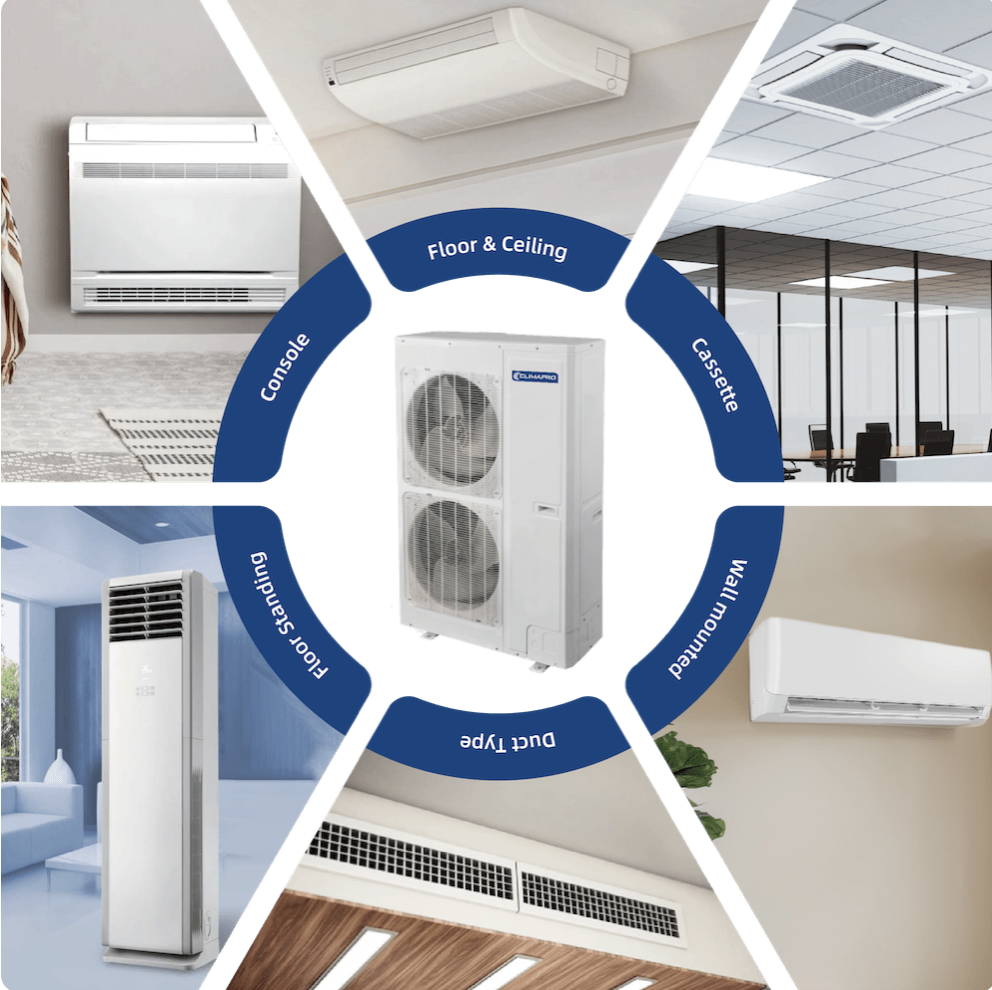
In VRF/VRV systems, a large number of indoor units can be connected to one or more outdoor units. Indoor units may be wall-mounted, cassette, ducted, ceiling-suspended or floor-mounted.
For the client, the key advantages are central management, independent room control, quiet operation, architectural integration and high energy efficiency.
Which VRF/VRV system suits which building?
The system should be selected according to how the building is used, the number of rooms, façade loads, pipe run lengths, fresh air requirements and any need for simultaneous heating and cooling.

Heat Pump VRF/VRV System
In heat pump VRF systems, all indoor units operate in the same mode at the same time, so the system is either cooling or heating. It is one of the most widely used solutions in hotels, offices, shops and residential developments.
The inverter compressor modulates capacity continuously according to the building’s demand. This results in more balanced operation and better-controlled electricity consumption than with conventional split systems.
Capacity, consumption and use
| Suitable buildings | Offices, shops, residential developments, villas, hotels, educational buildings |
|---|---|
| Advantages | High efficiency, independent room control, low noise, long pipe runs possible |
| Disadvantages | Some rooms cannot be cooled while others are heated at the same time |
Heat Recovery VRF/VRV System
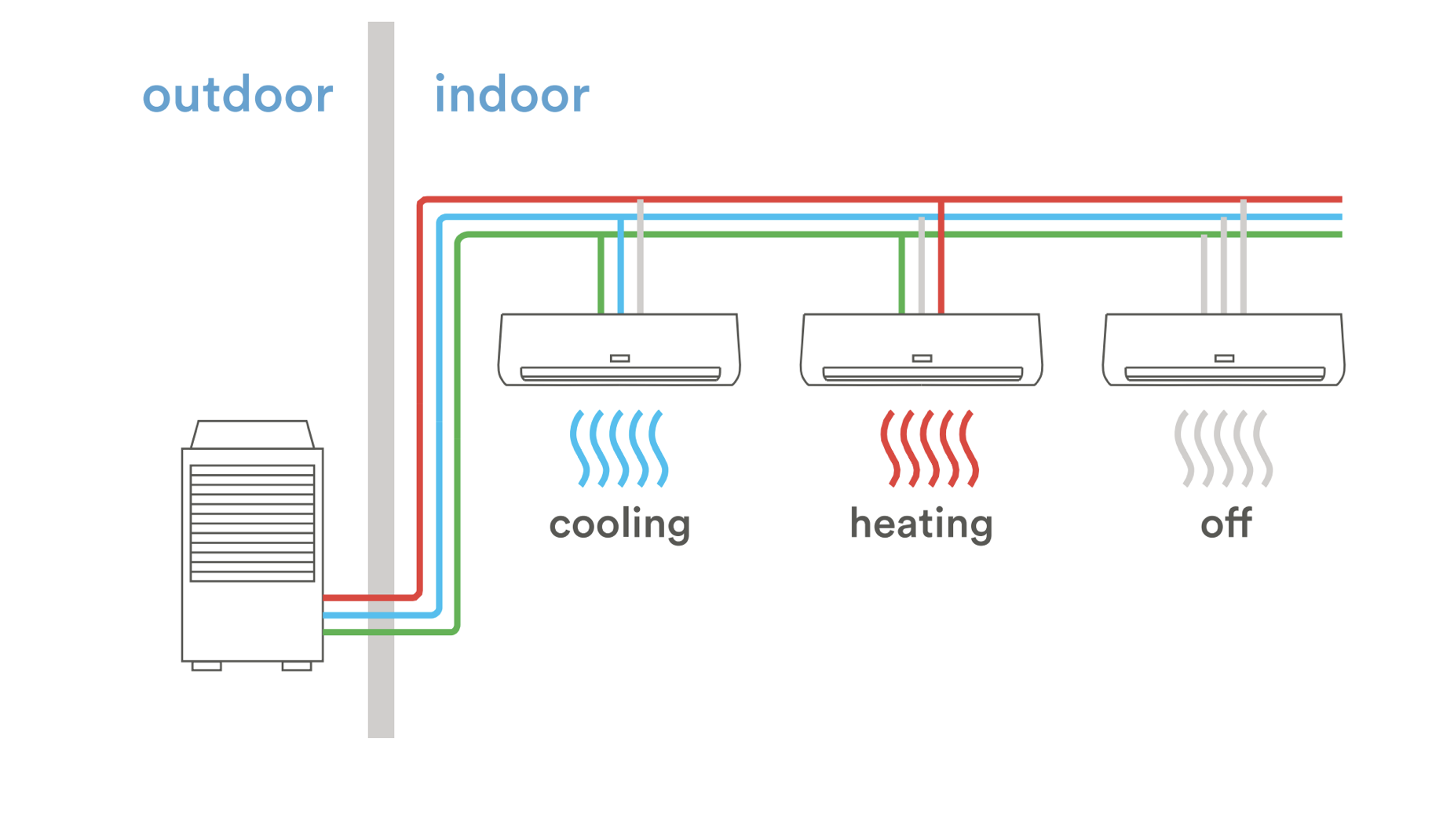
In heat recovery systems, some rooms in the same building can be cooled while others are heated. The system can transfer heat extracted from the zones being cooled to those calling for heating.
This is particularly advantageous in offices with glazed façades, hotels and large buildings facing different directions, where the south façade may need cooling while the north façade needs heating.
Energy efficiency and advantages
| Suitable buildings | Hotels, business centres, offices with glazed façades, hospitals, mixed-use buildings |
|---|---|
| Advantages | Simultaneous heating and cooling, high comfort, heat recovery |
| Disadvantages | More complex design, higher investment |
Mini VRF/VRV System
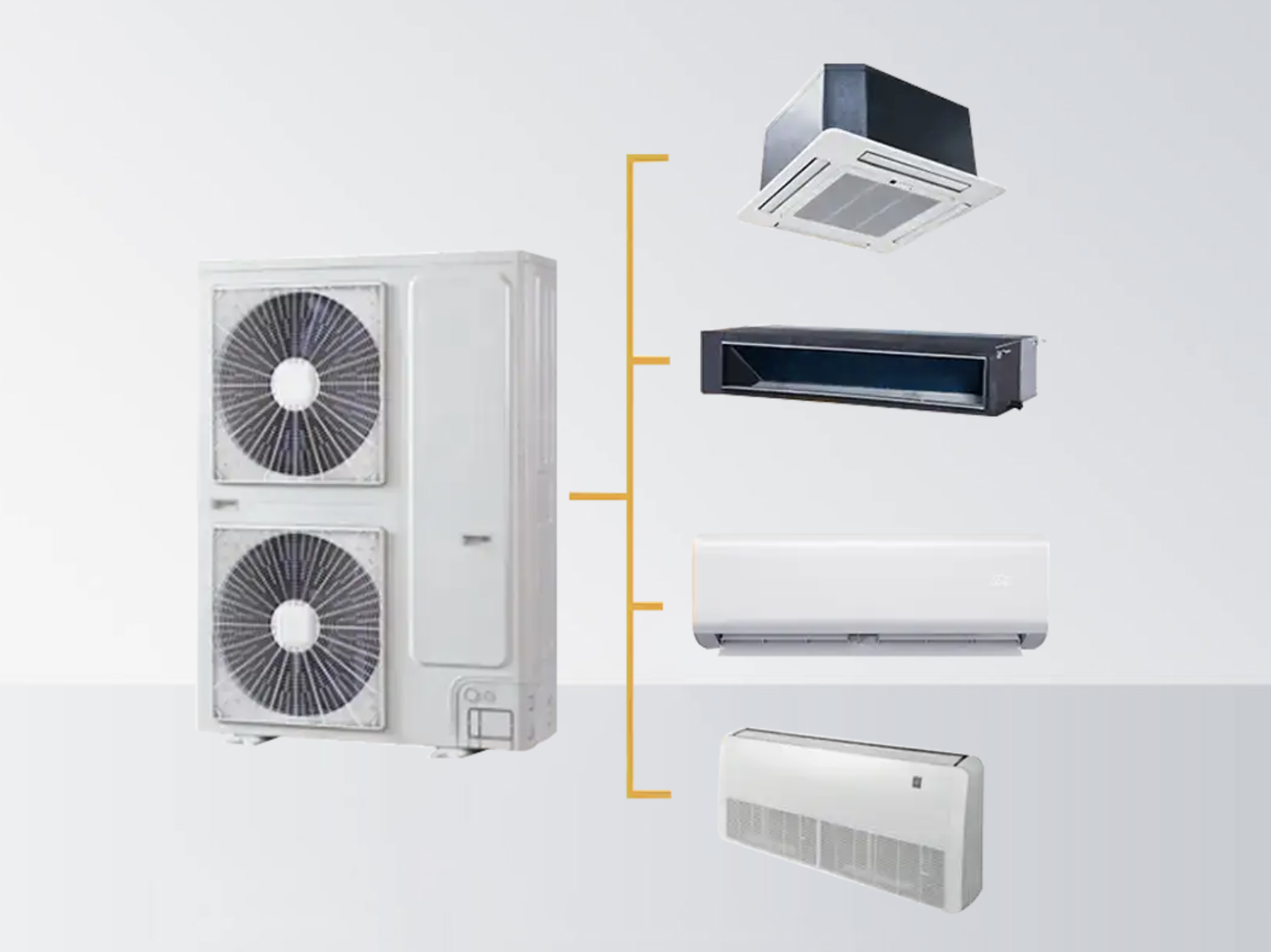
Mini VRF systems are more compact solutions for small and medium-sized buildings. They apply the principle of large VRF systems at a smaller capacity.
They are ideal for controlling several indoor units from one outdoor unit in villas, small offices, clinics, shops and boutique commercial premises.
Capacity and consumption
| Suitable buildings | Villas, small hotels, offices, clinics, boutique shops |
|---|---|
| Advantages | Compact outdoor unit, multiple indoor units, discreet solution |
| Disadvantages | Limited capacity for very large projects |
Water-Cooled VRF/VRV System
In water-cooled VRF systems, the outdoor unit exchanges heat with a water circuit instead of the air. It can work together with a cooling tower, boiler, geothermal source or central water circuit.
It may be preferred in high-rise buildings where outdoor units are difficult to place, in historic buildings or in projects where equipment should not be visible on the façade.
Technical applications
| Suitable buildings | High-rise buildings, hotels, historic buildings, large commercial complexes |
|---|---|
| Advantages | Flexible placement of outdoor units, compatibility with central systems, minimal impact on the façade |
| Disadvantages | Requires a water circuit, cooling tower or central infrastructure |
What should you consider when choosing a VRF/VRV system?
1. Capacity must be calculated room by room.
The total floor area alone is not enough. Façades, glazing area, occupancy, equipment loads and operating hours must all be taken into account.
2. Pipe run length is critical.
The distance and height difference between the outdoor and indoor units, as well as the copper pipe diameters, directly affect system performance.
3. The choice between heat pump and heat recovery must be made correctly.
If simultaneous heating and cooling is needed, a heat recovery system may be the better choice. If single-mode operation is sufficient, a heat pump system may be more economical.
4. Controls and maintenance must not be neglected.
Central controllers, room controllers, filter cleaning, condensate checks and regular maintenance are essential for a long service life.
Let’s design the right VRF/VRV system for your building together.
We will determine the most efficient system based on the floor plan, outdoor unit location, indoor unit types, pipe run lengths and usage scenario.