
Split Air Conditioners
Rapid Cooling, Efficient Heating and Year-Round Comfort.
Split air conditioners for apartments, villas, offices, shops, restaurants and small commercial premises provide high comfort, low energy consumption and a long service life when correctly sized and professionally installed.
Request a Quote for Your Project → Calculate Air Conditioning Capacity →A split air conditioner is a practical air conditioning system consisting of an indoor and an outdoor unit.
The system transfers heat from inside to outside. In heating mode, the process is reversed and energy taken from the outdoor air is transferred indoors.
In a split system, the indoor unit conditions the room air, while the outdoor unit, with its compressor and heat exchanger, performs the main energy conversion. Refrigerant circulating in copper pipes between the two units transfers the heat.
Modern inverter air conditioners adjust the compressor speed to demand and therefore run more evenly, quietly and economically than conventional on/off units. This is why they are chosen not only for summer cooling, but also for supplementary heating in spring and autumn and at suitable outdoor temperatures.
Every building and use calls for a different air conditioning solution.
The choice of air conditioner depends not only on the brand, but also on room size, ceiling height, façade orientation, glazing area, number of occupants, heat gains from equipment, noise level and installation options.
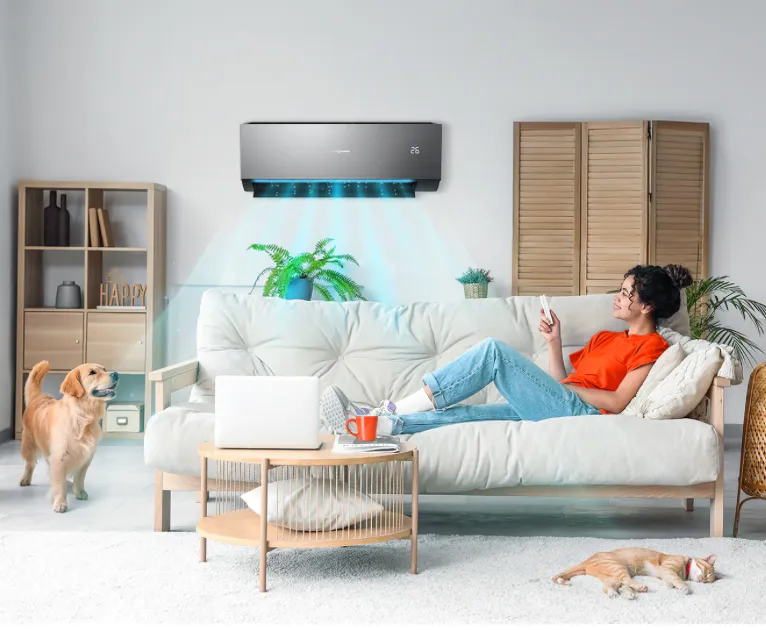
Wall-mounted split air conditioner
The wall-mounted split air conditioner is the most common type in homes and small commercial premises. The indoor unit is mounted on the wall, and the outdoor unit is placed on a balcony, façade, roof or in a suitable plant area.
Thanks to quick installation, reasonable cost, quiet operation and a wide range of capacities, it is a practical solution for apartments, offices, bedrooms, living rooms, small shops and consulting rooms.
Benefits and points to note
| Typical capacity | 9,000–24,000 BTU / approx. 2.5–7.0 kW |
|---|---|
| Electricity consumption | Approx. 0.45–2.50 kWh per hour, depending on operating mode, outdoor temperature and appliance efficiency. |
| Suitable buildings | Apartments, villas, small offices, bedrooms, living rooms, small commercial premises |
| Strengths | Economical, compact, quiet, quick to install, easy to service |
| Weaknesses | A single unit may not distribute air evenly in large or divided spaces. |

Multi-split air conditioning
In multi-split systems, two, three, four or more indoor units can be connected to one outdoor unit. Each indoor unit can be controlled independently in a different room.
This offers aesthetic and technical advantages for villas, apartments, offices and small commercial buildings where several outdoor units on the façade are undesirable.
Benefits and points to note
| Typical capacity | From 2 to 5 indoor units; total capacity varies by model. |
|---|---|
| Electricity consumption | Consumption varies with the number of indoor units running at the same time and the load. |
| Suitable buildings | Villas, apartments, office floors, small clinics, boutique businesses |
| Strengths | Fewer outdoor units, independent room control, a tidy façade |
| Weaknesses | The initial investment may be higher than for single split systems. |
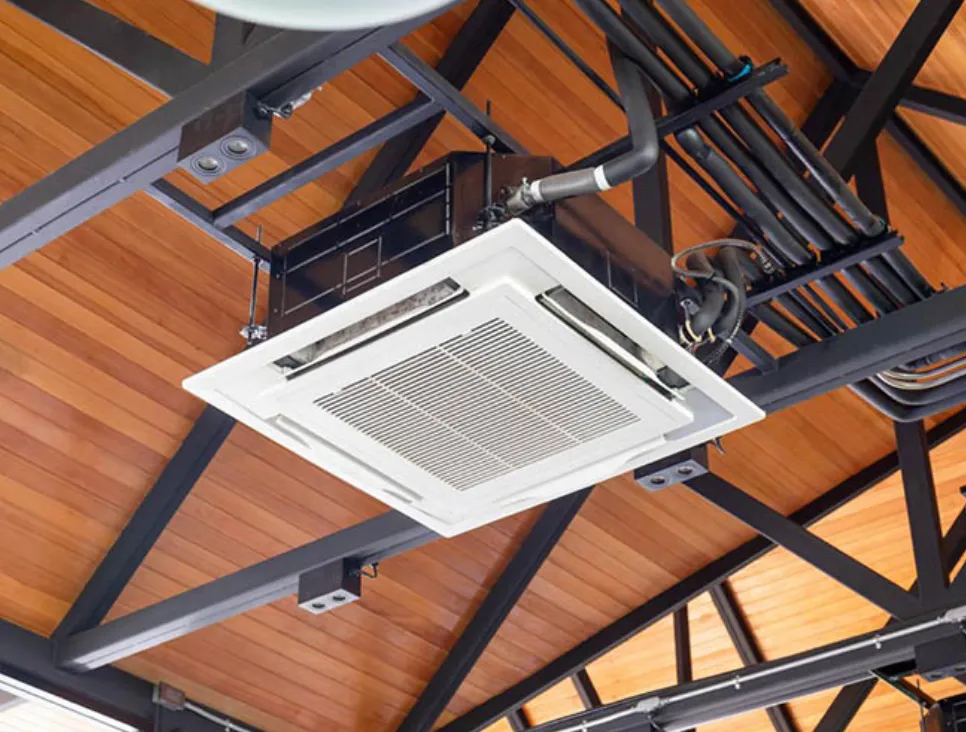
Cassette Split Air Conditioners
Cassette air conditioners are installed in a suspended ceiling and usually blow air in four directions. As a result, air distribution in large spaces can be more even than with wall-mounted units.
They are often chosen for open-plan spaces such as shops, showrooms, restaurants, offices, meeting rooms and hotel lobbies.
Benefits and points to note
| Typical capacity | 18,000–60,000 BTU / approx. 5–16 kW |
|---|---|
| Electricity consumption | Approx. 1.0–5.5 kWh per hour, depending on capacity and load. |
| Suitable buildings | Restaurants, shops, offices, showrooms, hotel areas |
| Strengths | Even air distribution, attractive appearance, suitability for commercial premises |
| Weaknesses | Requires a suspended ceiling, condensate drainage and service access. |
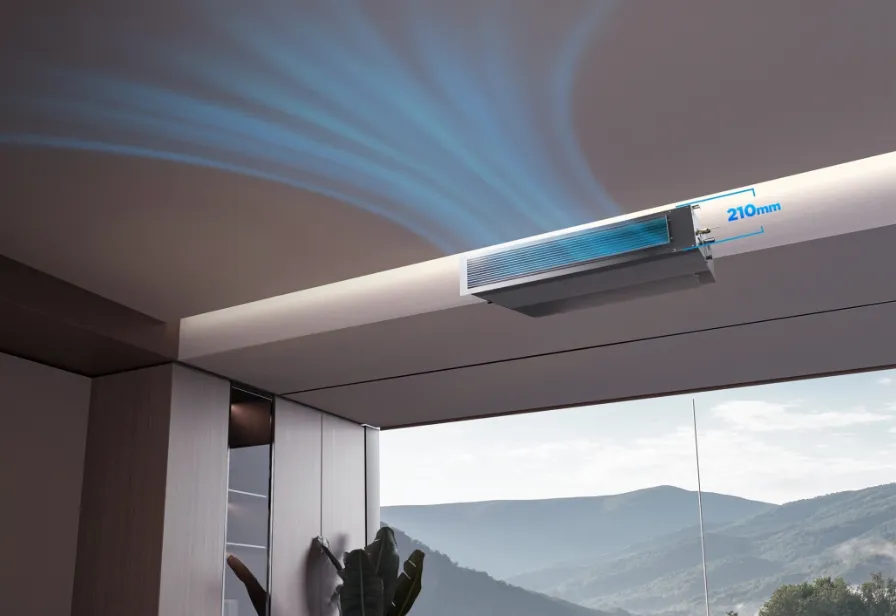
Ducted Split Air Conditioners
In ducted systems, the indoor unit is installed out of sight. Air is distributed to the rooms through ducts and grilles. This is one of the cleanest and most elegant solutions visually and architecturally.
It is chosen for villas, luxury homes, hotel rooms, offices, clinics and projects where interior design is important.
Benefits and points to note
| Typical capacity | 18,000–60,000 BTU / approx. 5–16 kW |
|---|---|
| Electricity consumption | Varies with unit capacity, duct pressure and fan speed. |
| Suitable buildings | Villas, hotels, luxury apartments, offices, clinics |
| Strengths | Concealed design, potential for quiet operation, architectural integration |
| Weaknesses | Design and installation quality are critical; costs may be higher. |
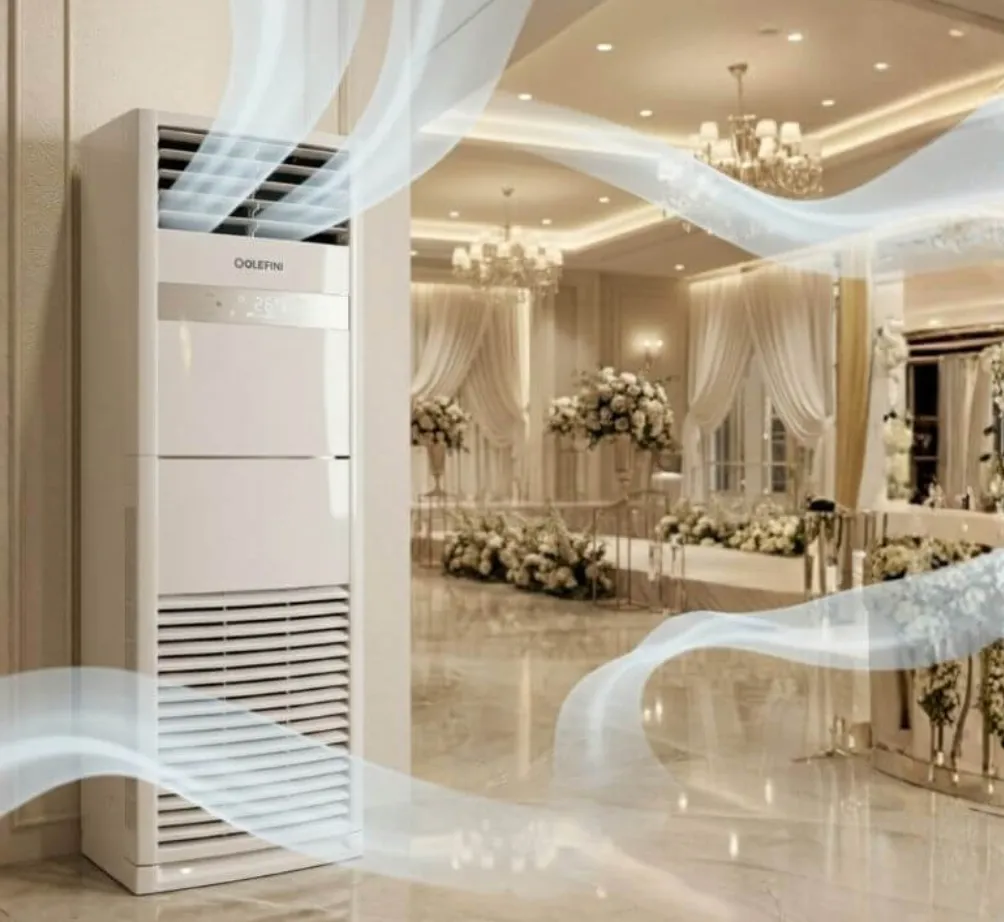
Floor-Standing Column Air Conditioners
Floor-standing column units are used in spaces that require high airflow and high capacity. The indoor unit stands upright on the floor.
They can be used in large halls, restaurants, supermarkets, showrooms, places of worship, meeting areas and large commercial spaces.
Benefits and points to note
| Typical capacity | 24,000–60,000 BTU / approx. 7–16 kW |
|---|---|
| Electricity consumption | Approx. 1.5–5.5 kWh per hour, depending on unit capacity and operating conditions. |
| Suitable buildings | Large halls, restaurants, shops, showrooms, places of worship |
| Strengths | High capacity, strong airflow, easy service access |
| Weaknesses | The large indoor unit may not suit every interior design. |
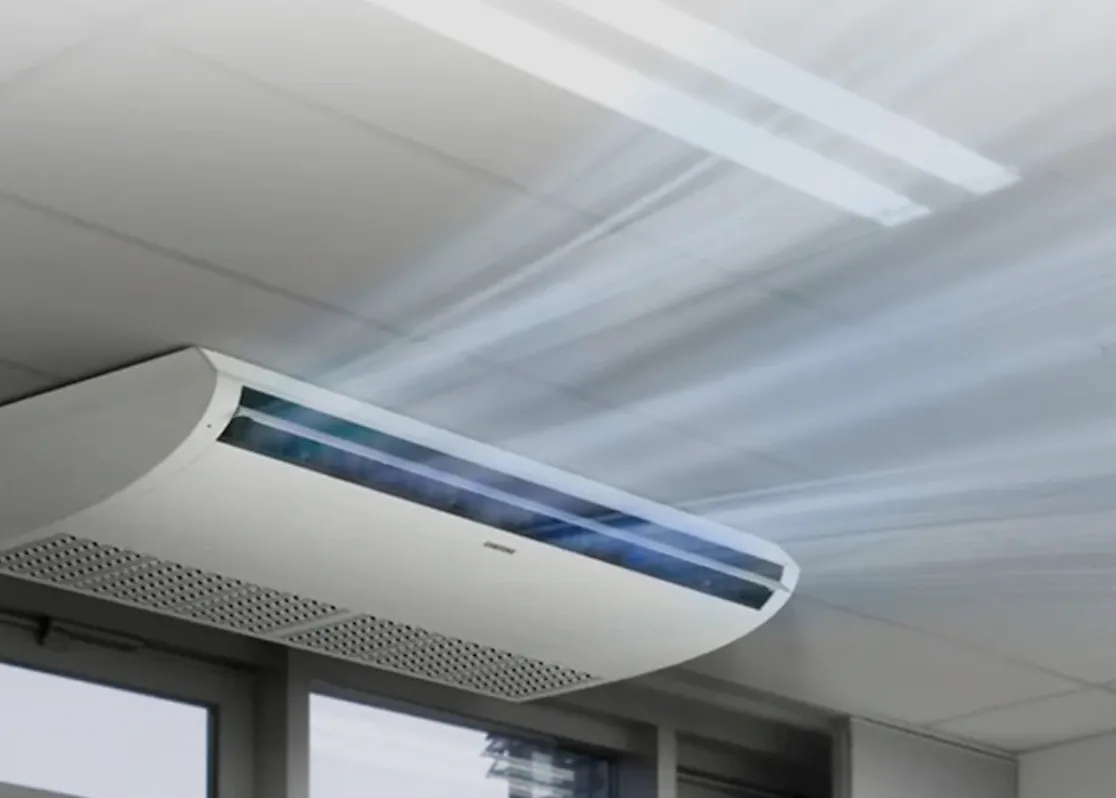
Ceiling-Suspended Split Air Conditioners
In ceiling-suspended systems, the indoor unit is mounted horizontally on the ceiling. It can carry the airflow forward across long, wide spaces.
They can be suitable for commercial premises without a suspended ceiling, restaurants, open-plan offices, workshops and long spaces.
Benefits and points to note
| Typical capacity | 18,000–60,000 BTU / approx. 5–16 kW |
|---|---|
| Electricity consumption | Approx. 1.0–5.5 kWh per hour, depending on fan speed and capacity. |
| Suitable buildings | Restaurants, offices, shops, workshops, long spaces |
| Strengths | Strong air throw, no suspended ceiling required, suitability for commercial premises |
| Weaknesses | Incorrect mounting height or direction can cause comfort problems. |
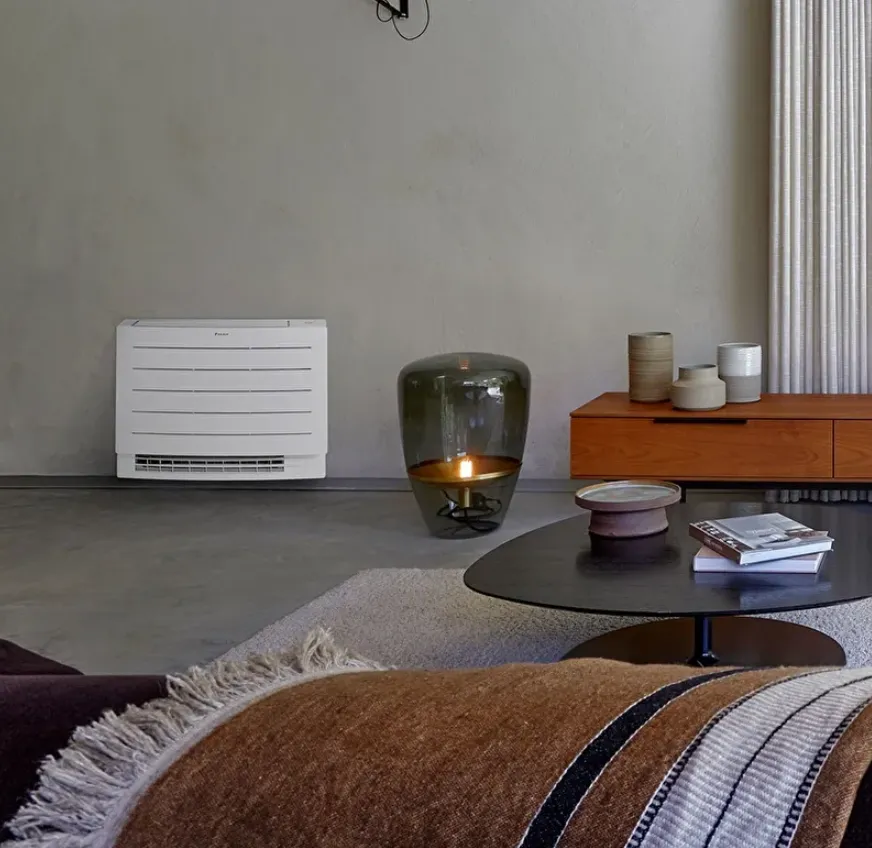
Floor-Mounted Split Air Conditioners
Floor-mounted air conditioners are positioned close to the floor, much like a radiator. They can be chosen for rooms where a unit high on the wall is unsuitable or for areas with a lot of glazing.
They can be a suitable alternative for conservatories, rooms with glazed façades, museums, offices, hotel rooms and spaces with architectural constraints.
Benefits and points to note
| Typical capacity | 9,000–24,000 BTU / approx. 2.5–7.0 kW |
|---|---|
| Electricity consumption | Approx. 0.45–2.50 kWh per hour, depending on operating conditions. |
| Suitable buildings | Rooms with glazed façades, hotel rooms, offices, conservatories, special architectural spaces |
| Strengths | Comfort close to the floor, an alternative architectural solution, quiet operation |
| Weaknesses | Furniture placement and clearance in front of the unit require attention. |
A BTU calculation must take more than floor area into account.
The values below are for an initial selection only. The actual capacity depends on façade orientation, window area, insulation, ceiling height, number of occupants and heat gains from equipment.
Suitable for bedrooms, small studies and small offices.
Often chosen for living rooms, small shops or medium-sized rooms.
Suitable for large living rooms, open-plan offices or small commercial premises.
Used in large living rooms, restaurant areas or open-plan commercial premises.
Suitable for commercial use with cassette, floor-standing or ceiling-suspended systems.
Shops, showrooms, restaurants and large commercial premises require a design calculation.
Pros and cons of split air conditioning systems
Advantages
- Provides rapid cooling and, under suitable conditions, economical supplementary heating.
- Inverter technology adjusts capacity to demand.
- Installation is quicker than for central systems.
- Offers comfort features such as Wi-Fi control, timers, quiet mode and dehumidification.
- Different indoor unit options are available for single rooms, multiple rooms or commercial premises.
Disadvantages
- Incorrect sizing increases energy consumption and reduces comfort.
- Performance can drop without filter cleaning and regular maintenance.
- In very cold climates, it may not be suitable as the main heating system for every project.
- The outdoor unit position, noise, condensate drainage and façade permits must be assessed in advance.
- In large or divided spaces, a single unit may not distribute air adequately.
Factors affecting energy consumption
The appliance’s energy class, SEER/SCOP rating, outdoor temperature, solar gain, window area, insulation quality, filter cleanliness, target temperature and operating hours all directly affect consumption.
Why is correct installation important?
If evacuation, copper pipe insulation, condensate fall, anti-vibration mounts for the outdoor unit, the electrical connection and leak testing are not carried out correctly, efficiency drops and the risk of faults increases.
What people ask about split air conditioners
Does a split air conditioner heat in winter?
Yes. Inverter air conditioners with a heat pump function can operate in heating mode. However, their suitability as the main heating must be assessed against the outdoor temperature and the building’s needs.
What is an inverter air conditioner?
An air conditioner that adjusts its compressor speed to demand. It offers more stable temperatures, quieter operation and the potential for lower consumption.
When should an air conditioner be serviced?
At least once a year for domestic use and more often for intensive commercial use. Filters should be cleaned regularly according to how heavily the unit is used.
Is an air conditioner with R32 refrigerant a good choice?
R32 is an efficient refrigerant used in many modern air conditioners. With correct installation and leak testing, it can be used safely.
Where should the outdoor unit be installed?
In a location with good air circulation and service access that is also suitable in terms of vibration and noise.
How long does an air conditioner last?
With a quality product, correct installation and regular maintenance, split air conditioners can operate efficiently for many years.
Which air conditioner is right for you?
Answer a few questions to see instantly the right type of air conditioner for your space and its approximate capacity in BTU.
Air conditioner brands we install and service
Click a brand to see its product ranges and the service we provide.


Let’s determine the right split air conditioning system for your building together.
We will plan the most suitable type and capacity of air conditioner based on room size, intended use, façade orientation, installation options and your expectations for energy consumption.