
Gas Boilers
Efficient, Safe and Controlled Heat Generation.
High-efficiency gas boiler solutions for central heating and hot water in houses, apartment buildings, hotels, office buildings and industrial facilities.
Request a Quote for Your Project → Compare Boiler and Combi Options →The gas boiler is the heart of a central heating system.
A boiler system of the right capacity, installed with the right pipework, improves comfort and keeps energy costs under control.
A gas boiler transfers the heat from burning natural gas to water. The heated water is then supplied to radiators, underfloor heating, fan coils or domestic hot water systems.
What matters to the client is not just the brand of the appliance. Boiler capacity, the flue system, pump groups, controls, safety equipment and hydraulic balance must all be considered together.
Which gas boiler suits which building?
Below are the most common types of gas boiler, with their technical features and practical benefits explained in plain terms.
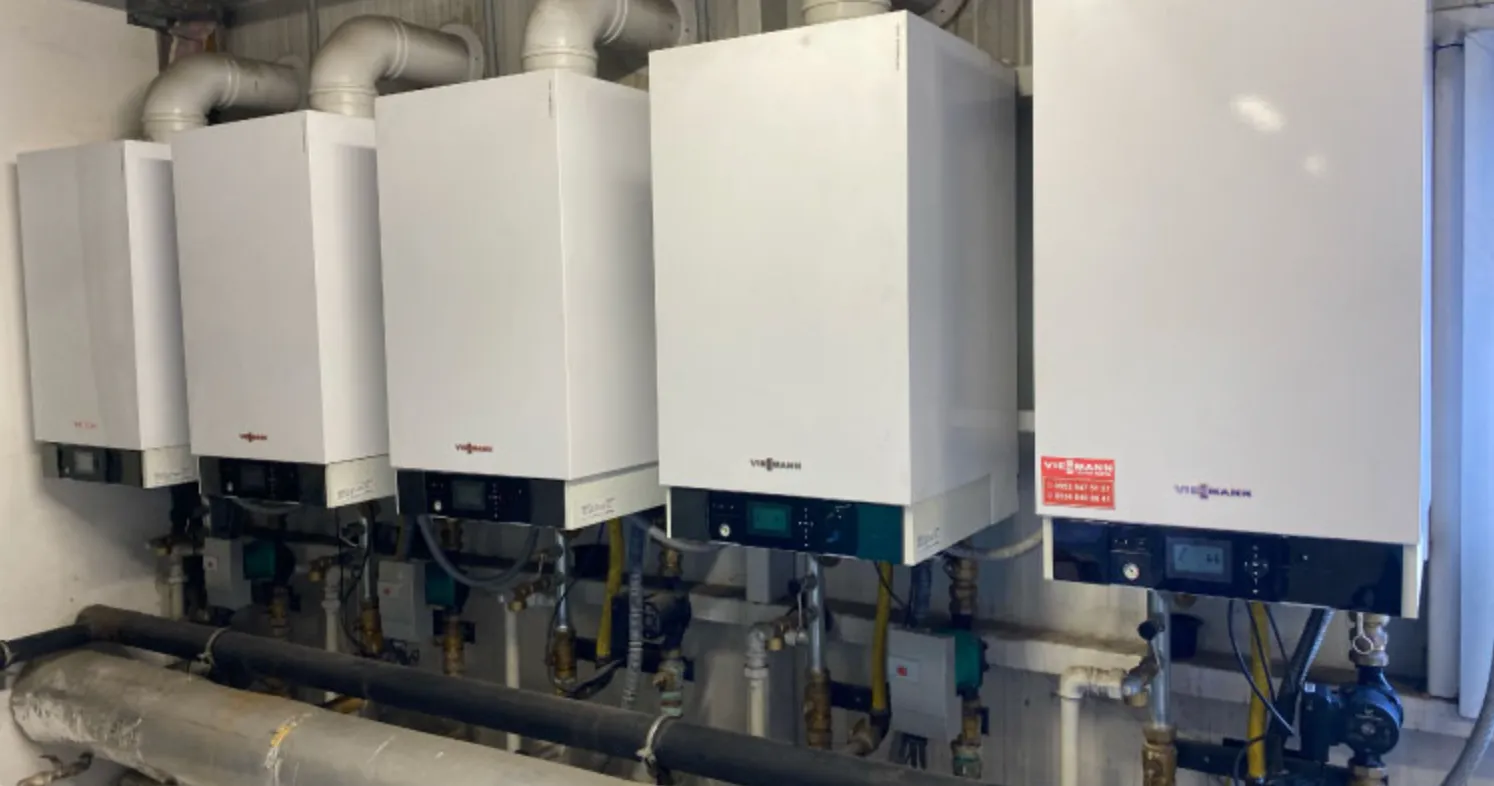
Condensing Gas Boilers
Condensing boilers also recover the energy contained in the water vapour of the flue gases produced by burning natural gas. As a result, they achieve higher efficiency than conventional boilers.
For the client, this means that the same heat demand can be met with less gas. Efficiency is particularly high with low-temperature underfloor heating and modern radiator systems.
Energy consumption and fuel costs
| Suitable building types | Apartment buildings, villas, hotels, offices, schools, commercial buildings |
|---|---|
| Technical advantage | High efficiency, low flue gas temperature, modulating operation |
| Client benefit | More even heating, potential for lower consumption, compatibility with modern systems |

Cascade Gas Boiler Systems
A cascade system is a central heating solution in which several boilers operate together. Depending on demand, the system can bring one boiler, several boilers or the entire group into operation.
This arrangement is particularly beneficial in buildings with variable heat demand. For example, high capacity may be needed in the morning, while lower capacity is sufficient during the day.
Energy consumption and operating logic
| Suitable building types | Hotels, residential complexes, hospitals, office buildings, large apartment buildings |
|---|---|
| Technical advantage | Modular capacity, redundant operation, automated control |
| Client benefit | More flexible use, continuity of operation in the event of a fault, controlled consumption |

Floor-Standing Gas Boilers
Floor-standing boilers are generally chosen for buildings with higher capacity requirements. They are installed on the floor of the boiler room and work together with the central system components.
In large buildings with continuous hot water demand or high heating loads, they offer a powerful and durable solution.
Energy consumption and applications
| Suitable building types | Factories, schools, hotels, public buildings, large commercial buildings |
|---|---|
| Technical advantage | High capacity, robust construction, compatibility with central systems |
| Client benefit | Strong heating performance, long service life, suitability for intensive operation |

Wall-Hung Gas Boilers
Wall-hung boilers are more compact. They are a good choice for small and medium-sized buildings where plant room space is limited.
They are usually used with condensing technology, and several units can be combined in a cascade system.
Energy consumption and practical use
| Suitable building types | Small apartment buildings, offices, villas, boutique hotels, commercial premises |
|---|---|
| Technical advantage | Compact design, easy service access, modular use |
| Client benefit | Small footprint, flexible capacity, easy maintenance |
What should you consider when choosing a gas boiler?
1. The largest boiler is not always the best choice.
An oversized boiler may cycle on and off frequently, which can increase fuel consumption. Capacity should therefore be calculated according to the building’s actual demand.
2. Fuel costs do not depend on appliance efficiency alone.
The radiator or underfloor heating system, pump selection, controls, insulation and usage habits all have a direct effect on gas consumption.
3. Condensing systems work more efficiently at low temperatures.
The lower the return water temperature, the greater the condensing effect. This is why they perform best with low-temperature systems such as underfloor heating.
4. The boiler room must be designed as a whole.
The boiler, flue, pump, expansion vessel, safety valve, controls and pipework must all be selected correctly together. Simply replacing the appliance is not always enough.
Which boiler or combi boiler is right for you?
Enter your building, fuel supply and hot water demand to see the suitable boiler type and approximate capacity instantly.
Boiler brands we install and maintain
Click a brand to see its product ranges and the service we provide.


Let’s determine the right gas boiler system for your building together.
We will plan the most suitable boiler solution based on how your building is used, its floor area, the condition of the existing installation and your hot water demand.